
A burst pipe at two in the morning costs more than a plumbing repair. It costs the sleep, the ceiling, the carpet, the dry-out, the repaint, and the relationship with the tenant who had to move out for a week. By the time the invoice settles, the total sits comfortably above what a year of planned maintenance would have cost.
This is the arithmetic that is pushing Dubai property owners toward annual maintenance contracts, and away from the call-a-guy-when-it-breaks model that dominated the city’s residential market for two decades.
The informal market worked, until it didn’t
For years, residential maintenance in Dubai ran on WhatsApp groups and watchman referrals. A building’s security guard knew an electrician. The electrician knew someone who cleaned AC coils. Payment was cash, records were verbal, and the system functioned well enough while the housing stock was new and failures were rare.
The stock is no longer new. Compressors rated for a decade of European use give five in Dubai’s climate, where ambient temperatures exceed forty-five degrees for months and coastal humidity loads condensate systems harder than any temperate-zone design assumes. Water heaters scale on hard mains supply. Flexible hoses perish under heat cycling. Sand loads filters and fouls condenser fins at rates that make quarterly servicing reasonable where annual might suffice elsewhere.
The informal market cannot keep up with that failure rate because it has no memory. Every callout starts from zero. A technician who has never seen your building does not know that the master bedroom unit has a history of condensate blockages, or that the isolation valve behind the laundry is stiff, or that the previous owner installed a non-standard cartridge that needs a specific part. Every diagnosis is a guess. Every fix is improvised.
What a contract actually changes
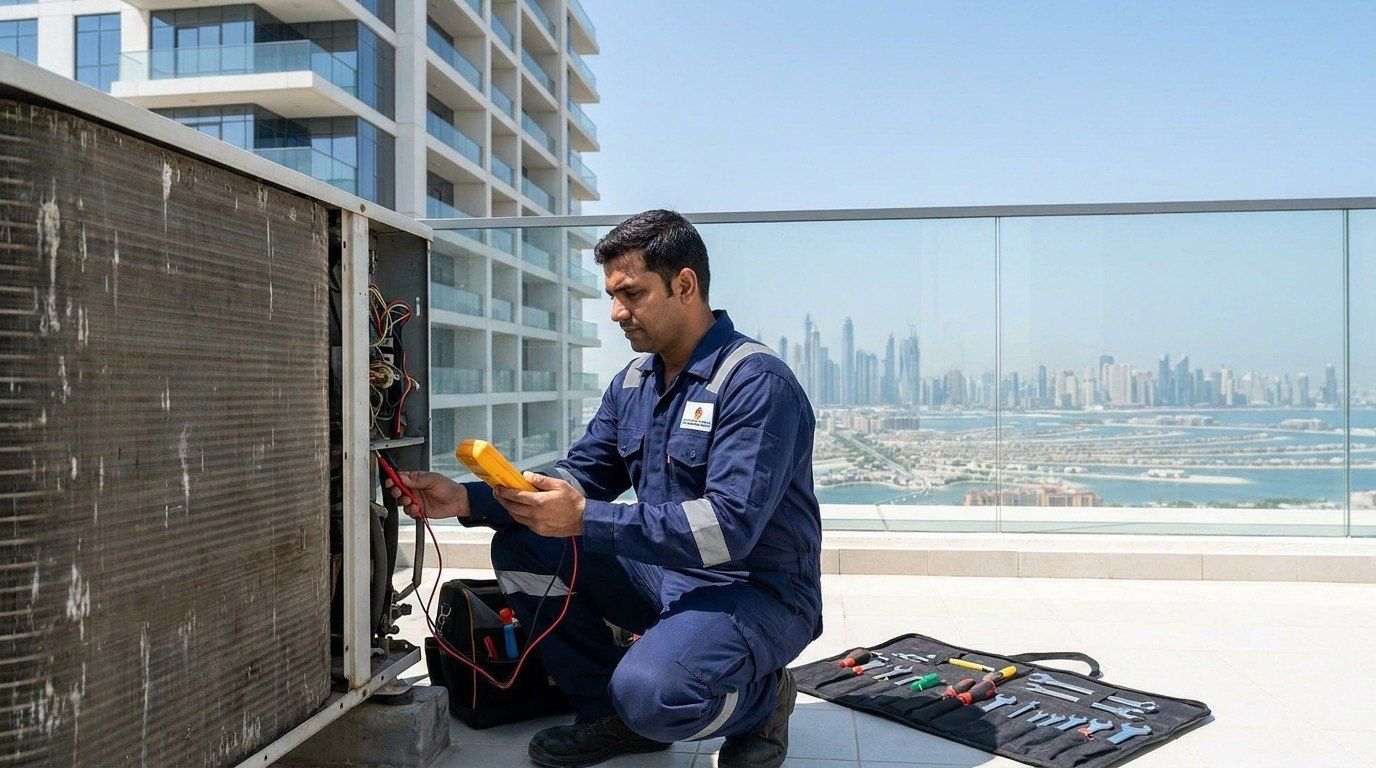
An annual maintenance contract replaces the panic-to-fix model with a scheduled one. A single provider takes responsibility for air conditioning, plumbing, electrical, and handyman work across the year on a fixed fee. The provider visits on a schedule rather than in an emergency, inspects systems before they fail, and keeps a record of what was found and done.
The structural difference is continuity. The same technician returns to the same property, accumulates knowledge about the building, and catches problems early. A condensate drain gets flushed before summer, not after it has stained a ceiling. Water pressure gets measured, because high pressure quietly destroys cartridges and flexible hoses. Silicone lines at shower tray junctions get inspected, which is where most bathroom water damage begins.
European Technical, a Dubai and Sharjah operator, illustrates the model. Its annual maintenance contracts start at AED 1,499 per year for apartment coverage with two AC services, annual plumbing and electrical inspections, and a four-hour emergency response commitment. The top-tier villa plan at AED 3,999 adds quarterly whole-property inspections, four AC services with no unit cap, duct cleaning, pest control, and handyman hours each quarter. Every visit produces a dated, photographed service report. Technicians are salaried employees, not day labour. The company offers a fourteen-day money-back window and allows cancellation after six months.
The documentation argument
The feature that most surprises new contract holders is the reporting. A dated, photographed record after every visit creates something the informal market never produced: a maintenance history for the building.
For landlords, that record settles deposit disputes and supports warranty claims against developers. For owner-occupiers, it forms a building history that has genuine value at resale. Two identical units in the same building, one with four years of documented quarterly servicing and one without, do not read the same to a buyer’s surveyor.
When a contract is the wrong call
The honest counter-case: a new-build apartment still inside developer warranty with one or two AC units probably costs less to maintain reactively for the first two or three years. Skip the contract, book a paid service once a year, and revisit when the warranty expires.
If the landlord genuinely handles all maintenance and the tenant is short-term, a contract duplicates the cost. And if you are the sort of person who strips and cleans a split unit yourself on a Friday, you are buying labour you do not need.
The direction of travel
European Technical reports that roughly seventy per cent of its new contract signups in 2026 are first-time buyers who previously relied on informal arrangements. The shift mirrors what has already happened in Singapore, Hong Kong, and the larger Indian metros, where contracted residential maintenance has been standard for over a decade.
Dubai’s climate makes the case harder to ignore. Equipment degrades faster here, the failure costs are higher, and the gap between preventive and reactive spending is wider. The property owners doing the arithmetic are arriving at the same conclusion, and the ones arriving earliest are the ones with the most to lose.